
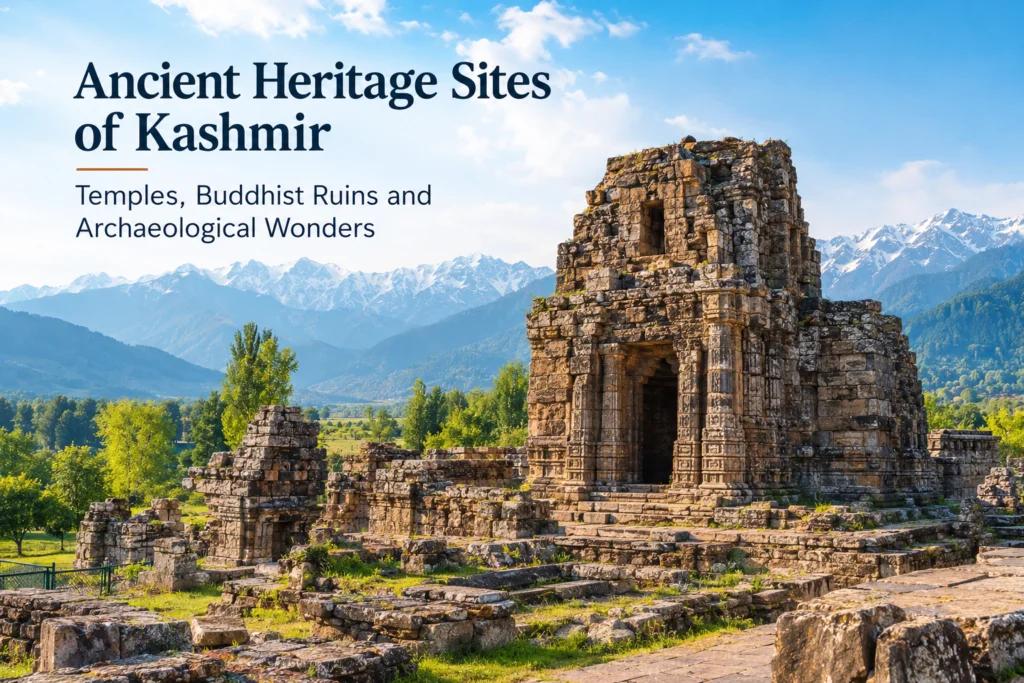
Quick answer: The most important ancient heritage sites of Kashmir are the Martand Sun Temple at Mattan, the Avantipur temples at Awantipora, the Naranag temple group in Ganderbal, Pandrethan, Harwan and Parihaspora, plus Burzahom, a Neolithic site near Srinagar. Most temples date from the 8th to 9th centuries under the Karkota and Utpala dynasties. You can see the main ones in about three days, starting from Srinagar.
Long before houseboats and tourist circuits, Kashmir was a centre of learning, art and architecture. Its kings raised grand stone temples, Buddhist monks gathered in monasteries, and Neolithic settlers lived in pits near what is now Srinagar. Many of these places still stand, some as weathered ruins and some as remarkably intact monuments, scattered across meadows, orchards and village lanes. This guide to the ancient heritage sites of Kashmir explains what each place is, how to fit them into a route and what to check before you go. For the wider picture, see our places to visit in Kashmir guide.
Kashmir’s Ancient Past in Brief
Kashmir’s recorded history goes back over two thousand years. The valley was an important centre of both Hindu and Buddhist thought and is associated with Kashmir Shaivism, a major philosophical tradition that developed around the 9th century. Many of the finest surviving stone temples belong to the Karkota period (roughly 625 to 855 CE) and the dynasties that followed, with most ancient temples in the valley dating between about the 8th and 12th centuries. For a broader timeline, read Kashmir: a brief history.
Time, earthquakes, climate and changes of rule have damaged most of these monuments, so what you see today is often ruins. Even so, they show the ambition and skill of ancient Kashmiri builders. The Archaeological Survey of India (ASI) protects a number of them as monuments of national importance.
Good to know: dates and attributions for ancient sites rest on texts such as the Rajatarangini, archaeology and local tradition, and scholars sometimes disagree. Treat the dates here as broad guidance.
Key Ancient Sites to Visit
Martand Sun Temple, Mattan (Anantnag)
The best-known ancient monument in Kashmir, built in the 8th century and attributed by the chronicler Kalhana to King Lalitaditya Muktapida. The ruins stand on a plateau above the Anantnag plain, with a central shrine inside a large colonnaded courtyard of smaller shrines. It is an ASI-protected site of national importance. Mattan is also known for its sacred springs, and a visit pairs well with Gurdwara Mattan Sahib, covered in our guide to gurdwaras and temples in Kashmir.

Avantipur Temples (Avantiswami and Avantisvara), Awantipora
Built under King Avantivarman, the first ruler of the Utpala dynasty, in the 9th century (construction is dated to about 853 to 855 CE). Two temples stand here on the bank of the Jhelum, one dedicated to Vishnu (Avantiswami) and the other to Shiva (Avantisvara). Both are ruined but still show carved stonework and the plan of a once-grand courtyard complex. The site is ASI-protected and sits on the Srinagar-Pahalgam route, which makes it an easy stop on the way to Pahalgam.

Naranag Temple Complex, Ganderbal
A group of 8th-century stone temples dedicated to Shiva, beside a spring in the foothills of the Haramukh range near Wangath village. The complex is an ASI-protected monument and is a starting point for the pilgrimage to Gangabal Lake and a common end point of the Kashmir Great Lakes trek. Update: Naranag was closed after the April 2025 Pahalgam attack and, according to ThePrint, was reopened to devotees and tourists on 20 June 2026 after a security review. Confirm current access before travelling.

Pandrethan Temple, Srinagar
A small, elegant Shiva temple standing on a platform in a spring-fed tank, dated by scholars to roughly the 8th to 9th century. It is one of the best-preserved ancient Kashmiri temples, and its two-storeyed pyramidal roof has largely survived. It lies inside the Badami Bagh army cantonment in Srinagar, so entry depends on current rules and permission. Ask locally before planning a visit and do not assume it is open.

Harwan Buddhist Site, Srinagar
Near Harwan and close to Dachigam, this site preserves the remains of an ancient Buddhist monastery complex with a terraced layout. It is known for the decorated terracotta tiles found by archaeologists, and local tradition links the area with early Buddhist gatherings. The peaceful setting makes it a rewarding short trip from Srinagar.

Parihaspora (Pattan), Baramulla
The ancient capital associated with King Lalitaditya, with the remains of a stupa, chaitya, monastery and temple foundations spread across a plateau. Much has been lost, but the scale of the site shows how important the city once was. Ushkur in Baramulla also has the excavated remains of an ancient stupa.

Burzahom, Srinagar
Burzahom is a prehistoric settlement about 16 km northwest of Srinagar and the northernmost excavated Neolithic site in India. Excavations by the ASI in the 1960s and early 1970s found four phases of occupation between roughly 3000 and 1000 BCE, including pit dwellings, tools and burials. It is less dramatic than the temples but important for understanding the valley’s first communities. The site is on India’s UNESCO tentative list. Check access and facilities before visiting.

Shankaracharya Temple, Srinagar
Crowning the hill above Dal Lake, this ancient Shiva temple has been a landmark of Srinagar for centuries. It has been repaired and altered over time, so its exact origins are debated. The view over the city and lake makes it one of the easiest heritage stops in a Srinagar itinerary; see our full Shankaracharya Temple guide for details. Security checks and timings apply.

Mamal and Payar Temples
The Mamaleshwar temple near Pahalgam is a small ancient Shiva shrine that many visitors pass without noticing. The tiny stone temple at Payar in Shopian is often cited as a fine example of Karkota-era architecture. Both suit travellers who want quieter, lesser-known stops.


Quick Comparison Table
| Site | Location | Best for | Approx. time |
|---|---|---|---|
| Martand Sun Temple | Mattan, Anantnag | Grand ruins, photography | 1 to 1.5 hours |
| Avantipur Temples | Awantipora, Pulwama | Easy highway stop, carved stonework | 1 to 1.5 hours |
| Naranag Temples | Ganderbal | Scenic setting, trek connection | 1 to 2 hours |
| Pandrethan Temple | Srinagar (army cantonment) | Intact temple structure, if access is allowed | 30 to 45 minutes |
| Harwan Buddhist Site | Srinagar outskirts | Buddhist heritage, quiet visit | 1 hour |
| Parihaspora | Pattan, Baramulla | Ancient capital, history lovers | 1 to 1.5 hours |
| Burzahom | Srinagar district | Neolithic archaeology | 45 minutes |
| Shankaracharya Temple | Srinagar | Views, easy half-day stop | 1.5 to 2 hours |
Visit times are planning estimates, not official figures.
What Makes Kashmiri Temple Architecture Special
- Local stone: Large blocks of limestone were cut and fitted with great precision.
- Triangular pediments and trefoil arches: Distinctive shapes over doorways and niches, with influences from Gandharan and Gupta traditions.
- Peristyle courtyards: Major temples such as Martand and Avantipur stand inside a courtyard surrounded by columns.
- Steep roofs: Designed for heavy snow, with pyramidal roof forms in surviving temples.
- Water setting: Temples were often built beside springs or in water, as at Pandrethan and Naranag.
A 3-Day Ancient Heritage Itinerary
- Day 1, Srinagar: Morning at Shankaracharya Temple, then Harwan and Burzahom if open, and sunset at Dal Lake. Add Pandrethan only if you have confirmed access.
- Day 2, South Kashmir: Drive to Awantipora for the Avantipur temples, continue to Mattan for the Martand Sun Temple, then stay in Pahalgam or return to Srinagar.
- Day 3, North or central Kashmir: Choose Naranag (check it is open, with an optional Sonamarg extension) or a day toward Baramulla for Parihaspora and Ushkur.
Use our distances from Srinagar guide to plan drive times, or book a driver through our cab services. For shrines and later religious heritage, see shrines in Kashmir and the top temples in Jammu and Kashmir.
Visiting Ancient Sites Responsibly
- Do not climb or sit on ruins, and never remove stones.
- Follow ASI rules and signs. Some sites restrict photography, drones or worship.
- Do not write or carve on walls, and carry your waste back.
- Respect sacred spaces: many sites remain important to local communities, so dress modestly and speak softly.
- Hire local guides where possible, as many sites have limited signage.
Please note: some sites sit in or near restricted or security-sensitive zones, and access, fees and timings can change. Carry government photo ID and confirm locally before you travel. Our guide on whether Kashmir is safe for family trips covers general travel precautions.
Practical Tips
- Best season: Spring and autumn give pleasant weather and clear light; summer also works, while winter snow can limit access. See the best time to visit Kashmir.
- Start early: Many sites are open-air with little shade, and the morning light is best.
- Wear sturdy shoes: Terrain can be uneven, stony or muddy.
- Carry water and snacks: Facilities at smaller sites can be limited.
- Plan the whole trip: Our guide to planning a Kashmir trip in 2026 covers permits, stays and budgets.
Frequently Asked Questions
1. What is the most famous ancient site in Kashmir?
The Martand Sun Temple at Mattan near Anantnag is widely considered the most famous and important ancient monument in the valley. It is an ASI-protected site of national importance and is attributed to King Lalitaditya Muktapida in the 8th century.
2. What are the Avantipur temples?
They are two ruined temples at Awantipora, Avantiswami (Vishnu) and Avantisvara (Shiva), built under King Avantivarman of the Utpala dynasty in the 9th century. They stand on the Srinagar-Pahalgam route and are protected by the ASI.
3. Is Pandrethan Temple open to tourists?
Pandrethan stands inside the Badami Bagh army cantonment in Srinagar, so access depends on current rules and permission. Check locally before you plan a visit.
4. Is Naranag temple open in 2026?
Naranag was closed after the April 2025 Pahalgam attack. According to ThePrint, the Lieutenant Governor ordered it reopened on 20 June 2026 after a security review. Conditions can change, so confirm before travelling.
5. Are there Buddhist heritage sites in Kashmir?
Yes. Harwan near Srinagar, Parihaspora and Ushkur in Baramulla preserve remains of ancient Buddhist monasteries and stupas. They are quieter than the main temple sites.
6. Which ancient sites can I visit in one day from Srinagar?
Avantipur and Martand make a good one-day trip in south Kashmir. Harwan, Shankaracharya and Burzahom can be combined in a half-day around Srinagar.
7. Is there an entry fee for ASI monuments?
Some ASI-protected monuments charge a small entry fee and others are free. Fees and timings change, so check on arrival rather than relying on a printed figure.
8. When is the best time to visit ancient sites in Kashmir?
Spring and autumn are most comfortable, with good light for photography. Summer works well too, while heavy winter snow can affect access to places such as Naranag.
Ancient Kashmir rewards slow travel: a few well-chosen sites, an early start and a local guide go further than a rushed checklist. Dates, rules and access can change, so verify locally before you travel.
Plan your heritage trip with Kashmir Tickets. Explore our Kashmir tour packages 2026 or browse all packages, hotels and destinations. Our Srinagar-based team can help with drivers and routes.